Storage You Can See Into: Planning the Lighting In and Around a Wide Medicine Cabinet
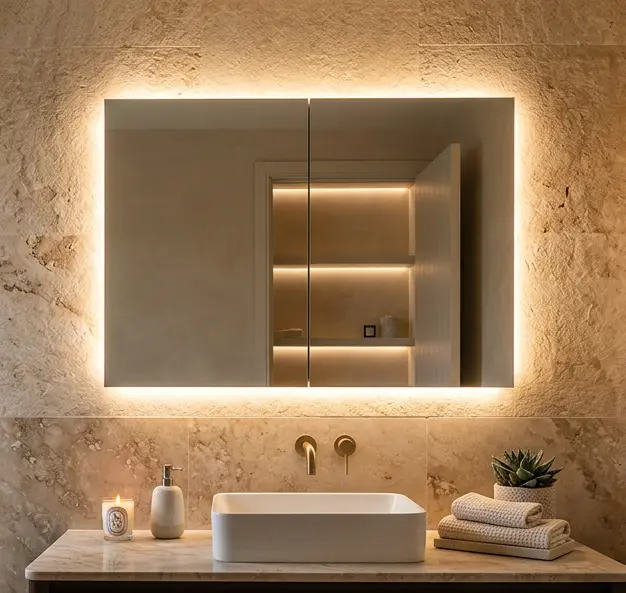
A well-lit reflection does not necessarily mean well-lit storage. When choosing a 40-inch lighted medicine cabinet, look at what happens after the doors open: whether labels remain readable, whether tall containers block smaller ones, and whether the user can reach what they need. These ordinary details determine how useful the cabinet feels long after installation.
Wide storage can encourage people to spread out their belongings without giving the arrangement much thought. A better approach is to plan the shelves and the surrounding lighting together. That makes it easier to find items without turning every morning into a search.
Check light with the doors open
Start by separating the light used for the mirror from the light available inside the cabinet. They serve different tasks. A bright face-level reflection tells you little about how clearly someone will see a small container on a shelf.
The current cabinet description lists both front lighting and interior lighting. That is useful information, but it does not answer every question about daily operation. Before buying, confirm how the interior light operates and how the controls are reached.
If a showroom demonstration is available, ask to view the cabinet both open and closed. Otherwise, request clear photographs or operating information that shows the interior. Do not assume a photograph with bright studio lighting represents the cabinet’s own light output.
Look at the areas behind shelf edges and beside tall bottles. A cabinet may appear bright overall while particular items remain difficult to see. The relevant test is whether the contents you plan to keep there are visible from your normal standing position.
Arrange shelves around real containers
Measure the items you use most often before deciding how the shelves should be arranged. Toothpaste tubes, skincare bottles, contact lens supplies, and grooming tools occupy different amounts of space. A layout based on those objects is more useful than one based on evenly spaced shelves.
The listed cabinet has three shelves and two doors. Review the actual interior layout and the permitted shelf positions before assigning storage zones. Exterior width does not tell you the usable width and height of every compartment.
Put smaller items where taller containers will not hide them. Keeping frequently used products close to the front can make them easier to identify, provided nothing can fall when a door opens. Avoid packing shelves so tightly that removing one bottle pulls another forward.
Use a simple shelf plan before filling the cabinet:
- Group items by task rather than by package color.
- Keep frequent-use containers within comfortable reach.
- Leave space to grasp bottles without moving their neighbors.
- Keep labels facing a position where they can be read.
- Follow each product’s storage directions and child-safety guidance.
Do not assume every medication belongs in a bathroom because the cabinet has that name. Check the label or ask a pharmacist about suitable storage conditions. Items that need a different environment should have a different home.
Coordinate interior light with the rest of the bathroom
Cabinet lighting should be reviewed alongside the fixtures already serving the room. Ceiling light, wall light, and daylight may all change what someone sees at the shelves. Test the arrangement at the times when the cabinet is actually used.
An open door can alter the way light reaches the contents or the person standing at the sink. Check the view with one door open and then with both open, where the instructions permit. Watch for reflections that make it uncomfortable to look at a label.
Adjustable brightness can be helpful, but it should not substitute for sensible storage placement. If a short container sits behind several tall bottles, increasing the light may not solve the obstruction. Move the objects before assuming the cabinet needs to be brighter.
Household preferences may also differ. One person may want stronger room lighting to read small print, while another prefers a lower setting for a brief nighttime visit. Agree on convenient settings and confirm the actual controls instead of relying on feature names alone.
Keep access and cleaning practical
A cabinet that is easy to see into should also be easy to reach into. Stand at the sink and consider the reach to each planned storage area. Frequently used items should not require leaning heavily over the counter or balancing on an improvised step.
Door clearance affects that access. Nearby lights, walls, and fixtures need to allow the movement required by the manufacturer. An installer should review the complete door path, not just the cabinet’s closed position on the wall.
Leave enough space around the faucet and cabinet bottom for cleaning. Water spots and residue can be harder to address when the gap is cramped. A slightly different mounting position may improve daily access, but it still needs to suit the users and installation requirements.
Follow the care instructions for the mirror, shelves, lighting, and controls. Do not spray liquid into electrical openings or assume every household cleaner suits every surface. Keeping a simple cleaning routine is easier when the shelves are not filled to their edges.
Review the cabinet as a working storage space
The value of a 40-inch lighted medicine cabinet becomes clearer when it is considered with its contents in place. Check whether the most-used objects are visible, reachable, and easy to return. Leave some breathing room so the arrangement can accommodate an ordinary change in toiletries.
Before making the final decision, compare the current cabinet details at Allsumhome with your shelf plan and the installer’s layout. Resolve questions about interior lighting, controls, and door access before installation. The aim is straightforward: a cabinet that makes daily items easy to find without adding extra steps to the routine.